Fully Laminated vs Frame Laminated Screen: Which One Is Better?
When evaluating replacement displays at scale, the difference between a fully laminated vs frame laminated screen goes far beyond structure—it directly affects visual performance, durability, repair cost, and long-term ROI for repair businesses and wholesalers. For B2B buyers, this is not just a technical comparison—it’s a strategic sourcing decision that influences margins, workflow efficiency, and customer satisfaction.
This guide combines industry insights and real-world repair scenarios to help you make the right choice.
What Is a Fully Laminated Screen?
A fully laminated screen uses optical bonding technology to eliminate the air gap between the LCD, touch digitizer, and cover glass. These layers are fused into a single unit using a transparent adhesive such as OCA (Optically Clear Adhesive).
This design significantly enhances display performance. By removing the air gap, internal reflections are minimized, allowing more light to pass through the panel. The result is a brighter, sharper, and more color-accurate display.
Key advantages:
- Higher brightness and improved contrast
- Reduced glare and better sunlight readability
- No internal dust accumulation
- More accurate and responsive touch experience (reduced parallax)
From a business perspective, fully laminated screens are typically sold as complete assemblies. This simplifies installation for technicians and reduces the risk of installation errors, but it also means higher replacement costs if damage occurs.
What Is a Frame Laminated Screen?
A frame laminated screen, often referred to as a non-laminated or air-gap display, keeps the LCD and touch panel physically separate. A bezel or frame holds the layers together, leaving a visible air gap between them.
This structure is widely used in cost-sensitive devices, particularly in education and enterprise markets.
Key advantages:
- Lower production and replacement cost
- Easier disassembly and repair
- Ability to replace individual components (LCD or digitizer)
- More flexible inventory management for parts suppliers
Key limitations:
- Increased reflection due to the air gap
- Slightly reduced display clarity
- Potential dust ingress over time
- Minor parallax effect in touch interaction
For high-volume repair operations, these trade-offs are often acceptable due to the significant cost savings.
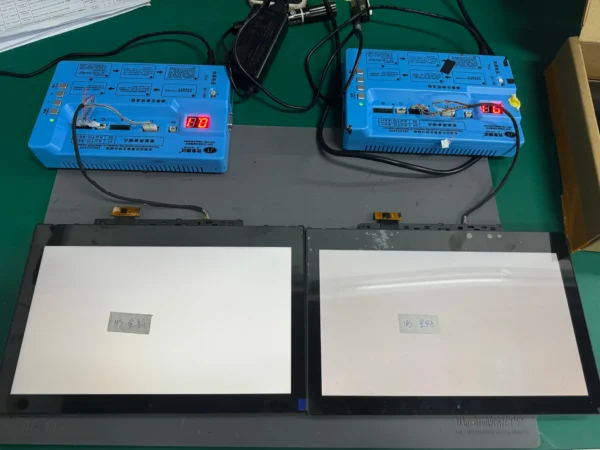
Fully Laminated vs Frame Laminated Screen: Core Differences
1. Optical Performance
Fully laminated screens outperform frame laminated ones in brightness, contrast, and visibility, especially in outdoor or high-light environments. The absence of an air gap reduces internal reflection and improves light transmission.
2. Touch Accuracy and User Experience
Because the display and touch layer are fused, fully laminated screens provide a more direct interaction. Frame laminated screens introduce a slight visual gap, which can affect precision in touch-heavy applications.
3. Repairability and Maintenance
Frame laminated screens clearly win in this category. Repair shops can replace only the damaged component, reducing cost per repair. Fully laminated screens usually require full module replacement.
4. Cost and Inventory Strategy
For wholesalers and distributors:
- Fully laminated screens = higher SKU cost, lower installation variability
- Frame laminated screens = lower cost, higher flexibility, better for bulk distribution
5. Application Scenarios
- Fully laminated: premium laptops, tablets, high-end Chromebooks
- Frame laminated: education devices, entry-level laptops, rugged enterprise units
Application Insight for High-Volume Chromebook Repairs
In the real world, most large-scale repair operations prioritize cost efficiency and turnaround speed over premium display quality.
This is especially true in the education sector, where devices are frequently repaired and budgets are tightly controlled. Frame laminated screens dominate in this segment because they allow flexible, low-cost repairs and reduce total cost of ownership.
For example, when sourcing parts like the Lenovo 300E 2nd Gen screen, buyers typically focus on availability, pricing stability, and ease of replacement rather than advanced display performance.
Manufacturing Detail That Impacts Long-Term Reliability
One often overlooked factor in the fully laminated vs frame laminated screen discussion is post-lamination processing quality.
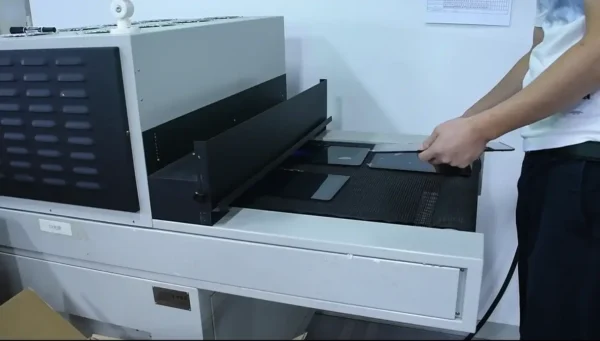
For example, suppliers like Laptop Defenders apply an additional UV curing process to all fully laminated screens. After the optical bonding stage, the screens go through a UV curing machine to further solidify the adhesive layer.
This process helps:
- Reduce the risk of LCD separation over time
- Improve bonding consistency across batches
- Enhance long-term durability under temperature and humidity changes
For B2B buyers, this kind of manufacturing detail can make a meaningful difference in reducing return rates and ensuring consistent product performance—especially in large-volume deployments.
Which One Should You Choose?
Ultimately, the answer depends on your customer base and operational priorities.
Choose fully laminated screens if:
- You serve higher-end repair markets
- Your customers value display quality
- You want standardized, module-based replacements
- You aim to reduce installation complexity
Choose frame laminated screens if:
- You handle school or enterprise contracts
- You prioritize cost efficiency and scalability
- You need flexible repair options
- You manage frequent, high-volume repairs
Final Thoughts
The fully laminated vs frame laminated screen comparison is not about which technology is objectively better—it’s about which one delivers better business outcomes.
- Fully laminated screens offer superior visual performance and modern user experience
- Frame laminated screens provide unmatched cost control and repair flexibility
For most B2B buyers—especially those serving education and enterprise markets—frame laminated screens remain the more practical and scalable choice. However, as demand for higher-quality displays grows, fully laminated screens are becoming increasingly relevant in premium repair segments.
Understanding both technologies allows you to align your sourcing strategy with market demand, optimize your inventory, and ultimately improve profitability.